Recognize the pattern
The accusations change. The pattern doesn’t.
Old lies, new screenshots. Each short guide pairs history with today's version and linked sources, in plain language.
About & Methodology
What We Are
This educational resource traces modern antisemitic claims to their historical origins: where they started, how they have been reused, and what the factual record supports or contradicts.
We are not an advocacy project, a political campaign, or a response to any single event. We are a reference built on encyclopedias, government archives, court and trial records, wire reporting, and peer-reviewed scholarship, with Holocaust museums and civil-rights monitors cited where they document current patterns or hold primary materials.
Who This Is For
The material is written in plain language for classrooms, newsrooms, and general reference. It is meant to sit alongside primary sources and standard histories so that specific claims can be checked against documentation rather than rumour.
The focus is on evidence and pattern: what archives, trials, and historians record, and how certain accusations have recurred across centuries. Some articles examine rhetoric in public statements by named public figures; those pieces analyze documented claims and recurring patterns, not private individuals for harassment. We map claims to the record.
Our Approach
Every trope page follows the same backbone: then-and-now comparisons, where the lie came from, a timeline, how it appears online today, what the record shows, pattern cues, and a behavioral checklist (what you can do). The top of each page adds framing and a short excerpt from the factual correction so readers see intent before the longest sections.
Editorial principles:
- Frame the pattern first, then history. Trope pages open with what the trope claims, a one-line statement that it is false and that we map how it returns, a short excerpt of what the record shows, and only then the deep history. The goal is prebunking-style clarity before the heaviest material.
- Show the pattern, then name it. Older and newer versions appear side by side so the continuity is easy to compare.
- Use plain language. Jargon, dense academic framing, and insider activist vocabulary are avoided unless a term is defined.
- Link to real evidence. Claims point to museum archives, encyclopedias, court records, or established civil-rights research that can be opened directly.
- Acknowledge complexity. When a correction is partial or context-dependent, the text says so.
- Informational tone. The writing aims to inform, not to accuse or lecture.
Fit with education research
Classroom and international guidance often splits antisemitism education into three strands: cognitive learning (facts, definitions, analysis), socio-emotional learning (attitudes, empathy, knowing Jewish people as more than targets of hate), and behavioral learning (what to say, report, or teach in real settings). We built these pages to support the first strand in depth; the homepage section What works alongside these pages and each trope's "What you can do" block point to the second and third so we do not stop at debunking alone.
Research on misinformation also emphasizes prebunking: show people how a false claim or tactic usually works before they meet it without context. Trope pages use that idea by stating the editorial line up front, naming the pattern, and pairing samples with correction.
Rigorous proof that any single website changes deeply held hate is scarce. We still align layout and copy with what major museums, established international classroom frameworks, and civil-rights monitors recommend: primary sources, plain language, contemporary examples, and explicit next steps.
Methodology
Each trope page is built from a structured research process:
- Identify the claim as it currently circulates on social media, in political rhetoric, or in news reporting.
- Trace the history using original documents and expert histories, noting the earliest examples and when the story resurfaced loudly.
- Document the modern version using reports from monitoring organizations (ADL, CyberWell) and established journalism, and, where a definition of antisemitism is needed, citable text from official government pages (European Commission overview, U.S. National Strategy PDF).
- State what the record shows and where the claim breaks (wrong facts, twisted logic, or contradicted by evidence).
- List pattern cues describing how the same story often appears in new wording or on new platforms.
- Add behavioral guidance (reporting, sharing discipline, classroom pairing with Jewish life and Holocaust history from museums and archives) so the page is not only analytical.
All sources are linked directly from each page. We mix encyclopedias, university archives, government pages, and wire hubs with Holocaust museums and civil-rights monitors so different kinds of evidence can be compared.
What We Are Not
We do not argue that criticism of Israel is antisemitic. The working definition of antisemitism that is often called the "IHRA definition" (adopted by the International Holocaust Remembrance Alliance; here, cited from the European Commission) explicitly states that criticism of Israel similar to that leveled against any other country is not antisemitic. What we document is something different: recurring conspiracy frameworks that predate the current political moment by centuries and that target Jews as a group.
We are not affiliated with any government, political party, or lobbying organization. We are an independent educational project.
For the full list of sources used across all pages, see the Sources & Bibliography page.
Same accusation, different century
History on the left, a recent example on the right. Same shape, new words.
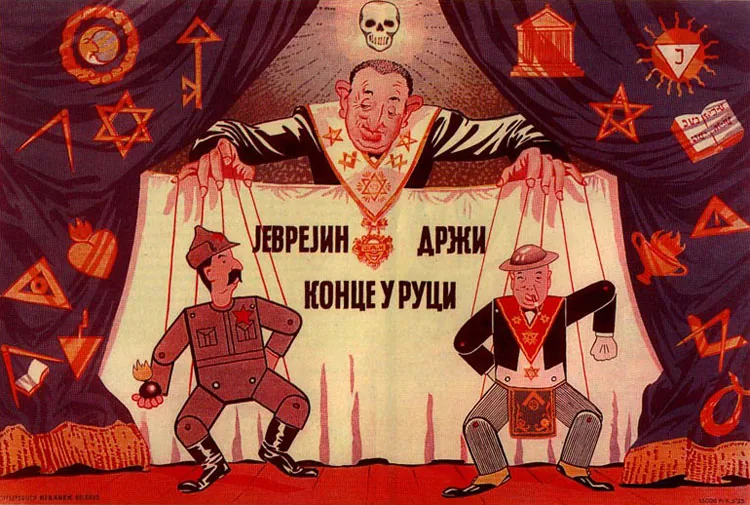
Public domain archival poster (copy hosted here; catalogued via Wikimedia Commons)
Occupation-era propaganda poster
World War II: a poster aimed at readers in Nazi-occupied Yugoslavia. It shows a grotesque Jewish caricature holding puppet strings. On the ends of the strings are Churchill and Stalin (the UK and Soviet leaders). The image claims Jews and Freemasons (a fraternal group conspiracy theories often lump in as a secret world power) run the Allies and drag them into war. Nazi Germany reused that "hidden hand" idea in many countries.
Social posts and news cycles
In 2024-2026, posts claiming "Zionists" will drag America into "WWIII" spiked when the Middle East heated up. News and monitoring reports tied those waves to the same old "Jews start wars" line that resurfaced after 9/11 and the Iraq War.
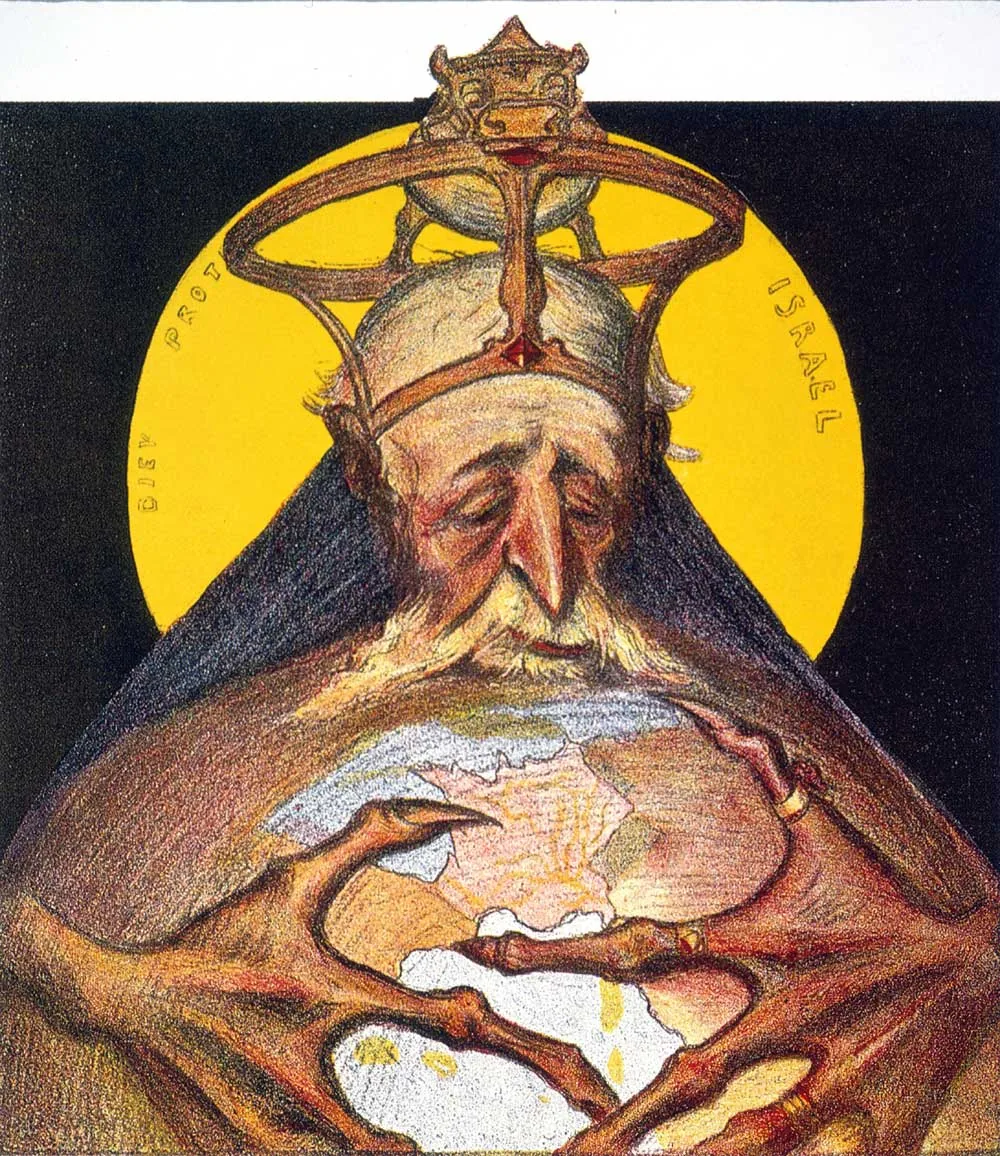
Public domain (Léandre, 1898; copy hosted here via Wikimedia Commons)
Magazine caricature
1898: a French magazine cover shows a Rothschild figure hugging a globe like a king. The Rothschilds were a real, wealthy banking family; the cartoon turns them into secret rulers of all finance. Today's Rothschild memes say the same thing in pixels.
Social feeds
"The Rothschilds control every central bank" still circulates as memes and video scripts during election cycles and Middle East news spikes: same structure, new medium.
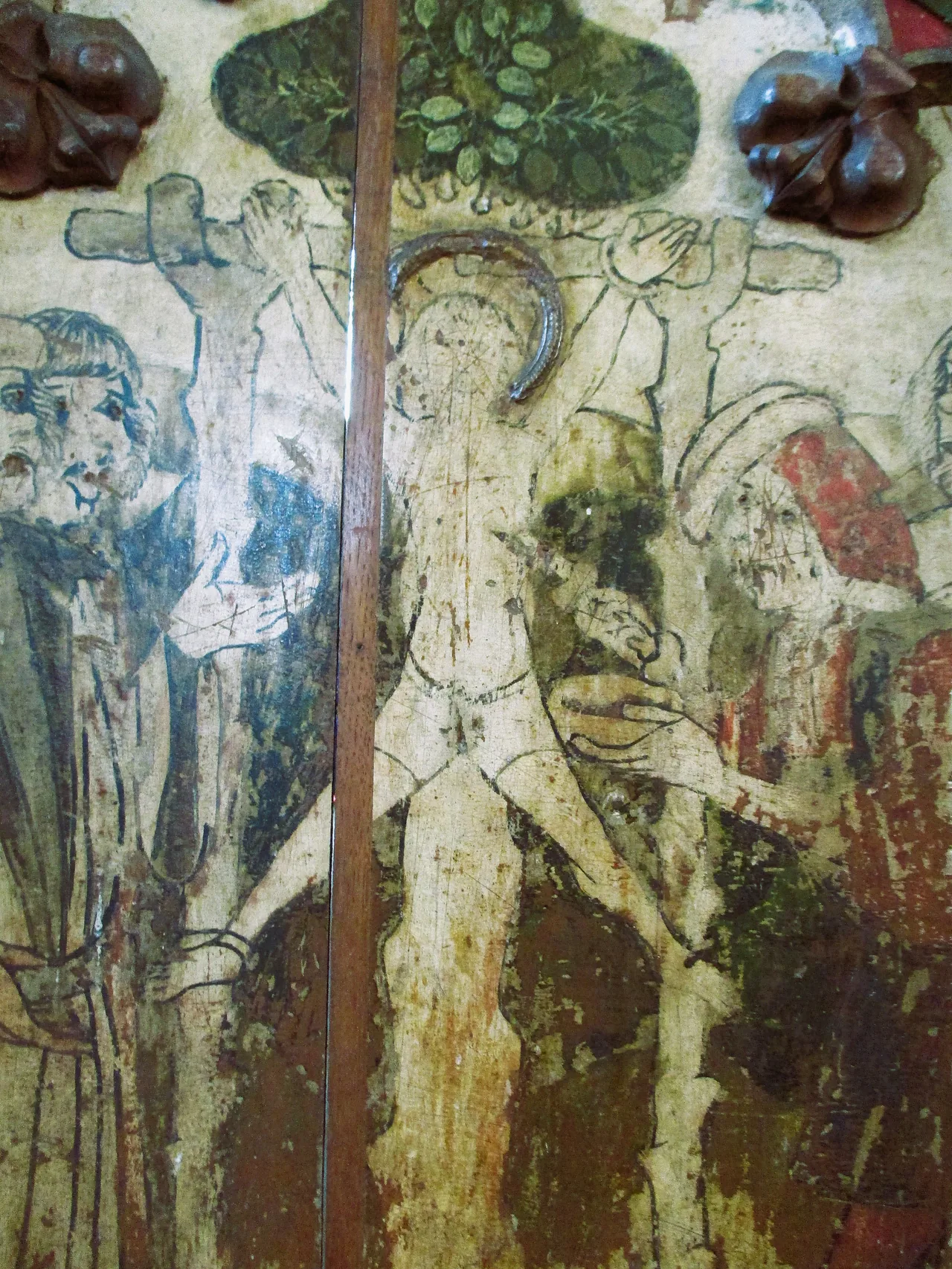
Public domain artwork (copy hosted here via Wikimedia Commons)
Medieval chronicle
Norwich: a boy dies; monks spread the story that Jews ritually murdered him. No evidence, but the template is born.
Online imagery
Memes and cartoons still show Israeli leaders drinking blood or eating children; news and monitoring reports tracked spikes during 2023-2025 conflict cycles.
Why the pattern matters
These stories did not stay on paper. Blood libel is the false claim that Jews murder children for religion; in medieval Europe it helped spark violence against Jewish communities. The Protocols of the Elders of Zion was a forged book pretending to expose a Jewish world plot; the Nazis and others spread it widely. Dual loyalty smears (saying Jews are not really loyal to their own country) have been used to shut people out of jobs, schools, and citizenship.
When a whole group is called secretly evil, that talk rarely stops at words.
How to spot the pattern
Four quick pattern checks for recycled accusations. Tap to expand.
1Is this blaming one group for a complex event?
Big events (wars, crashes, pandemics) usually have many causes. Conspiracy thinking picks one hidden group and says they did it all. That shortcut shows up from the Black Death to today.
2Is this a "hidden mastermind" claim?
If the post says Jews secretly run banks, media, or governments behind the scenes, it is copying a playbook from The Protocols of the Elders of Zion (a forged early-1900s text that pretended to leak a Jewish master plan). The names change. The idea (one hidden Jewish hand pulling strings) does not.
3Does this accusation predate the current event by centuries?
Blood libel (the false claim that Jews kill children for rituals) is medieval. "They control the money" is centuries old. Dual loyalty smears (the claim that Jews are not real citizens) are older than the modern state of Israel.
4Does it blame the same group for opposite things?
Jews get blamed for capitalism and communism, for running the media and for censoring it, for open borders and for nationalism. When one group is the villain for every opposite problem, that is conspiracy logic, not facts.
What works alongside these pages
Classroom and policy guides often split antisemitism education into three kinds of learning: facts and analysis, attitudes and human context, and what to do in real life. We are strongest on the first; the other two still matter.
Facts and patterns
Naming a trope, tracing its history, and checking claims against sources matches how media-literacy and "prebunking" research build resistance: you see the tactic before it hits you at full volume.
Jewish life, not only danger
Jews are a diverse, global community with many languages, beliefs, and daily lives. Learning only through myths risks a flat picture. Pair trope literacy with ordinary Jewish history, culture, and voices.
What you can do
Changing minds usually takes trusted relationships, not one article. You can still slow harm: pause before sharing, report clear hate on platforms, and send people to documented history when they ask for proof.
- National Archives: Holocaust-related records (U.S. government research guide)
- European Commission: combating antisemitism (includes the IHRA working definition in EU work)
- Open any trope for a "What you can do" checklist
Guides by topic
Pick a pattern. Short history, how it shows up now, and sources.
"Jews Start Wars"
Blaming Jews for starting wars or dragging nations into them. The war changes; the finger-pointing script does not.
Timeline from 1903 · 8 timeline entries
"Jews Control the Media, Banks, and Politics"
The story that Jews secretly run money, news, and politics. The targets change with the news; the hidden-hand idea does not.
Timeline from 12th to 15th c. · 7 timeline entries
Blood Libel
The lie that Jews murder children for rituals. It began in medieval Europe and still shows up in memes, posts, and political talk.
Timeline from 1144 · 9 timeline entries
"The Talmud Teaches Hatred of Non-Jews"
The Talmud is Judaism's huge library of rabbinic debate and religious law (not one simple rulebook). Viral posts claim it orders Jews to hate outsiders; the quotes are usually wrong, ripped from an argument, or not in the book at all.
Timeline from 1240 · 6 timeline entries
Dual Loyalty and "Zionist" as a Proxy for Jews
The claim that Jews are not really loyal to the country they live in, or that "Zionist" is just a coded word for Jew. Old suspicion, new packaging.
Timeline from 1700s to 1800s · 6 timeline entries
Holocaust Inversion and Distortion
Saying Jews "use" the Holocaust for politics, or calling them "the real Nazis," twists genocide history against the people it targeted. That pattern started almost as soon as the war ended.
Timeline from 1945 to 1950s · 6 timeline entries